Top 5 Kratom Strains for Energy: A 2026 Guide

How long does kratom last timing and effects guide image

Last Updated: October 12, 2026

How Kratom Strains Are Named and Why It Matters

Kratom strains are named for two things: the color of the leaf vein at harvest and the region where the tree grew. That naming system is the only map you get when comparing products, so it pays to understand what the labels actually promise.

This guide from INDOKRATOM.CA will be upfront about something most vendor pages skip: strain names are marketing shorthand, not lab-verified categories. Two batches of “White Maeng Da” from different suppliers can differ in alkaloid content. What matters more is how the plant was dried, when it was harvested, and whether the seller tests each batch.

Kratom strains are informal trade names that combine a vein color with a growing region, such as White Thai or Green Malay. The label tells you the general direction of reported effects, not a guaranteed result. Most of what people describe, energy, focus, alertness, comes from the balance of alkaloids like mitragynine and speciogynine in that particular batch.

Keep reading, and we will walk through the questions to ask before you buy any of them.

Kratom Strains by Color: What the Labels Tell You

Vein color is the first filter most buyers use, and it is a reasonable starting point. Leaf veins shift color as the leaf matures, and harvesters sort accordingly. The convention is simple:

  • White vein: picked early, commonly described as the most stimulating
  • Green vein: mid-maturity, often called balanced
  • Red vein: fully mature, usually associated with relaxation rather than energy
  • Yellow vein: a less standardized category, often a drying-method variant

Here is the honest caveat. These categories come from traditional use and vendor convention, not controlled trials. There is no regulatory body that certifies a strain’s effect profile, and no Canadian standard defines what “white vein” must contain.

That does not make the labels useless. It makes them a starting point. If you want stimulation, white and green are the logical first look. If you want the opposite, you already know red is not your answer.

Watch OutThe biggest mistake new buyers make is treating a strain name as a potency guarantee. A weak batch of White Maeng Da will underperform a strong batch of Green Malay every time. Judge the batch, not the label.

Kratom Strain Chart: A Quick Comparison

Use this table as a starting filter, then read the individual sections below for the reasoning behind each pick. Before the table, here is how the five were selected, because a ranking without stated criteria is just a list.

Selection criteria used for this top five:

  1. Frequency of mention across publicly available strain guides and community discussions, not vendor marketing pages.
  2. Distinctness of reported profile, each pick had to occupy a different slot (sharp stimulation, balanced energy, clean focus, steady all-day energy, and a variable blend).
  3. Separation of reported effects from evidence-backed conclusions, every profile below is labeled as reported, not proven.

A note on evidence quality: there are no controlled human trials establishing that White Maeng Da produces more energy than Green Malay. The categories below come from traditional use, vendor convention, and self-reported experience. Treat them as a starting hypothesis, not a chemical guarantee.
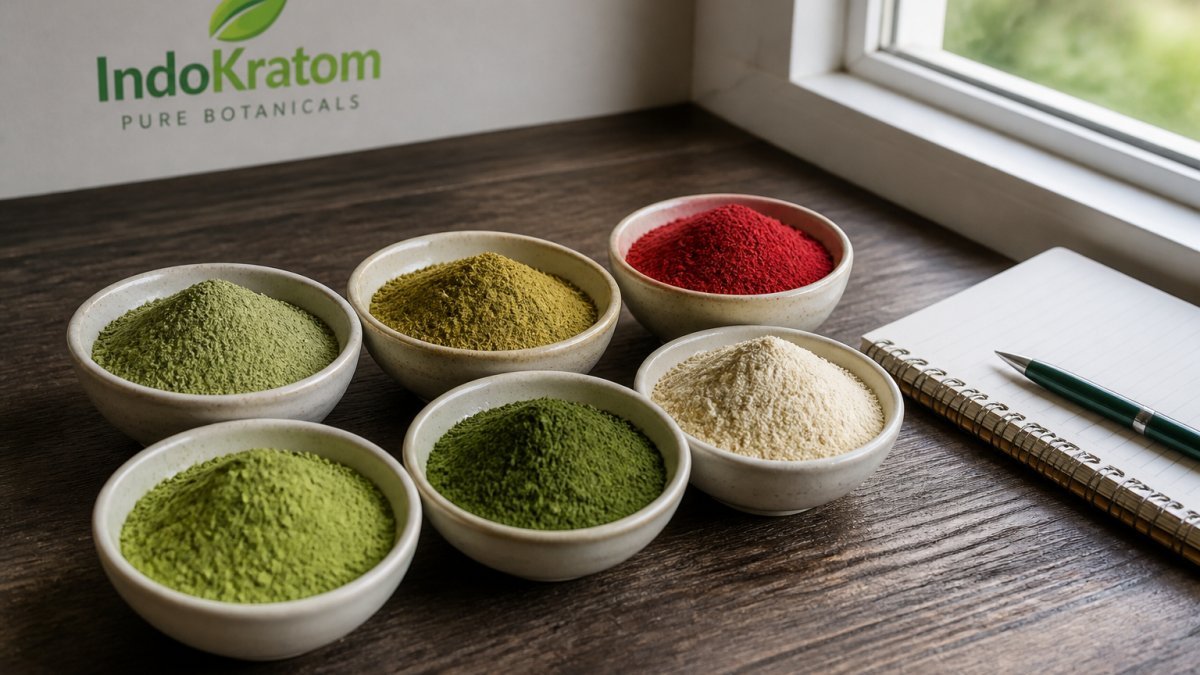
Comparison chart of kratom strains displayed as colored powders in ceramic bowls on a wooden table
Strain Vein Color Commonly Reported Profile Best Suited For Batch Consistency
White Maeng Da White Sharp stimulation, strong alertness Early mornings, deadlines Moderate, varies by drying method
Green Malay Green Balanced energy, mood elevation Long workdays Generally consistent when tested
White Thai White Clean focus, lighter body feel Detail-heavy tasks Moderate, origin claims vary
Green Borneo Green Steady energy, calm focus All-day use Variable, Borneo covers a large landmass

Two things the table cannot show. First, batch variation: a strain chart is a map of reported effects, not a chemical assay. Alkaloid content shifts with harvest timing, plant age, drying method, and storage. Second, product quality: independent testing for contaminants and batch-specific analysis matter more than the strain name on the label.

Watch OutStrain names are informal trade labels. No regulator certifies what “White Maeng Da” must contain, and two batches sold under the same name can differ noticeably in alkaloid profile. Judge the batch, not the label.

1. White Maeng Da

White Maeng Da is a white-vein product.

The “Maeng Da” name itself is worth understanding. It originated as a Thai term implying a grafted or enhanced plant, and today it functions as a quality claim more than a botanical fact. Any seller can label a product Maeng Da. Not every seller can show you why theirs deserves the name.

Pro TipIf you are coming from green strains, White Maeng Da will feel noticeably sharper. Judge the batch on its own merits rather than on the name.

2. Green Malay

Green Malay is a green-vein strain associated with Malaysia.

3. White Thai

White Thai comes from Thailand and carries a white vein.

4. Green Borneo

Green Borneo comes from the island of Borneo.

Shop Today! →

The regional origin matters here: Borneo covers a large landmass, and growing conditions vary, so Borneo-labeled products can differ more than the name suggests.

Key TakeawayThe best energy strain for you depends less on the name and more on the batch. A tested Green Malay will beat an untested White Maeng Da almost every time.

How to Choose Between These Strains

Work through this checklist before you order. It covers the practical questions most guides skip.

Start with your target effect.

  • Note that Maeng Da blends vary widely, only choose them if you already know how you respond to individual strains

Then consider the safety context that strain guides rarely mention.

Kratom products are not approved for human consumption in Canada, and the regulatory picture continues to evolve. Health Canada has issued advisories about kratom products, and rules can change.

A few practical points worth knowing:

Finally, track your own response.

That last point matters more than any strain chart. Keep notes on amount, timing, and effect so you can compare across purchases rather than relying on the strain name alone.

Frequently Asked Questions

What kratom is used for energy?

These effects are based on reported experiences, not clinical trials, so individual results vary.

What do kratom strain colors mean?

Vein color refers to the color of the leaf’s central vein at harvest. These labels are not standardized, so the same color name can differ between suppliers.

Are kratom strain names standardized?

No. Strain names like Maeng Da or Borneo are marketing labels, not botanical classifications. The same name can describe different alkaloid profiles depending on the supplier, harvest time, and region.

What does research say about kratom and energy?

Research on kratom is limited and mostly focuses on its alkaloids, such as mitragynine and speciogynine. There is no strong clinical evidence that specific strains reliably boost energy. Treat strain effects as general tendencies, not guaranteed outcomes, and prioritize product quality and safety.

Finding a strain that works for you is only half the problem. The other half is finding a seller whose label actually matches the batch inside the bag, and that is where most buyers get burned. At INDOKRATOM.CA, every botanical product is lab tested for safety and quality, sold strictly for research use, and listed on a simplified site built to load fast and stay up during busy ordering periods. Browse the current strain selection and check batch details before you buy.
How to Compare Kratom Strains for Beginners (2026)

How long does kratom last timing and effects guide image

Last Updated: October 5, 2026

Why Comparing Kratom Strains Is Harder Than It Looks

Learning how to compare kratom strains for beginners looks simple on paper. You read a label, pick a color, and expect a result. In practice, most labels tell you far less than they seem to. This guide from INDOKRATOM.CA walks through a practical comparison method built for people who are new to this.

Most strain names are marketing, not science. Two products with the same name can differ in alkaloid content, grind, and freshness.

That gap is the whole problem. You are not comparing effects. You are comparing labels.

A strain chart is a starting point, not a guarantee. Below, we break down what the words actually mean and how to compare products in a way that holds up.

Kratom Strain Labels Explained: What the Words Actually Tell You

Kratom strain labels explained simply: a label usually combines three separate things into one name. Those are the vein color, a place name, and a made-up trade name. Each part carries a different weight.

Strain Name vs. Vein Color vs. Origin

Vein color describes the color of the leaf’s central vein at harvest. Red, green, white, and yellow are the common categories. Origin refers to where the leaf was grown, such as Borneo or Sumatra. The trade name is the part a seller invents, and it carries the least information.

Why Two Products With the Same Name Still Differ

Same name does not mean same product. Drying method, harvest timing, grind size, and storage all shift the final alkaloid profile. A red from one batch will not match a red from another.

Watch OutTreating a strain name as a fixed specification is the most common beginner mistake. You will judge a whole color category off one product that may not represent it at all.

Kratom Vein Colors Explained: Red, Green, White, and Gold

Kratom vein colors explained in one line: color is a rough sorting label tied to harvest timing and drying method, not a precise measure of effect. Red, green, white, and gold are the main groups buyers see, and each is usually described with a different effect profile.

What the Color Labels Usually Refer To

  • Red vein: leaves harvested later in the plant’s life cycle, often fermented or sun-dried longer. Commonly described as the most calming and sedative-leaning.
  • Green vein: harvested mid-cycle, dried quickly. Often placed in the middle, a reported balance of energy and calm.
  • White vein: harvested early, dried fast. Often described as the most stimulating.
  • Gold vein: the least standardized category. Sometimes a distinct harvest, sometimes a drying variation. Frequently described as a milder middle ground.

Why Color Is a Weak Predictor

The reported effects are usually attributed to two alkaloids: mitragynine and 7-hydroxymitragynine. Their ratios vary with plant age, region, drying method, and storage, not with vein color alone. A red-veined leaf dried fast can end up with a profile closer to a green, and a white-veined leaf stored poorly can lose much of what made it distinct.

That is why two products with the same color label can feel completely different. Color tells you roughly where a leaf sat in its harvest cycle. It does not tell you the alkaloid ratio in the bag in front of you.

What Actually Moves the Needle

Ranked from strongest signal to weakest:

  1. Lot-to-lot consistency, does the same product behave the same way across batches?
  2. Your own logged observations, repeated, controlled, written down.
  3. Origin and drying method, meaningful context, but not a guarantee.
  4. Vein color, a sorting label. Useful for narrowing a list, useless as a promise.

A Note on Reported Effects

Everything above describes patterns people report, not measured outcomes. Individual response varies widely with sensitivity, serving size, format, and prior experience. Treat color as the first filter in your comparison, never the last word.

Watch OutDo not judge an entire color category off a single product. One poorly stored red tells you nothing about reds as a group, it tells you something about that batch.

How to Read a Kratom Strain Chart Without Over-Trusting It

A kratom strain chart is a comparison grid that lines up colors, origins, and reported effects. It is useful for orientation. It is not evidence.

Charts are usually built from vendor descriptions and customer anecdotes. So treat any chart as a hypothesis you test, not a fact you accept.

What most guides miss is that a chart tells you what to expect, not what you will get. Use it to narrow your list. Then compare the actual products.

Step-by-Step: A Beginner’s Method to Compare Kratom Strains

Here is the process we suggest. It takes about 20 minutes and gives you a record you can reuse.

Step-by-step guide to compare kratom strains using a notebook and labeled packets of botanical powder.

  1. Pick one variable. Compare colors only, or origins only. Never both at once.
  2. Fix your serving size. Use the same amount for every product you compare.
  3. Note the format. Powder, capsules, and tea behave differently. Keep format constant.
  4. Record the basics. Write down product name, vein color, origin, and lot number.
  5. Log your response. Note timing, duration, and how you felt. Keep it factual.
  6. Space your tests. Leave days between products so effects do not overlap.
  7. Repeat once. A single result is noise. A repeat is a pattern.

Build Your Own Comparison Worksheet

Copy this table and fill one row per product.

Shop Today! →

Product

Vein Color

Origin

Format

Serving Size

Lot Number

Response Notes

Sample A

Red

Borneo

Powder

Same for all

Sample B

Green

Malay

Powder

Same for all

Sample C

White

Sumatra

Powder

Same for all

Pro TipChange one thing at a time. If you switch color, origin, and format together, you learn nothing about which one caused the difference.

What Strain Charts and Color Claims Get Wrong

The evidence behind color-based claims is thin. Most of it is anecdotal, and much of it comes from sellers. There is no standard that maps a vein color to a guaranteed effect.

That does not make color useless. It makes color a weak signal. Use it to sort, not to decide.

The stronger signals are the ones you can check: lab testing, lot consistency, and your own logged results. That is the difference between a claim and a fact.

Key TakeawayCompare the product in front of you, not the color on the label. Color narrows the field. Testing and your own records settle it.

Product Quality, Verification, and What to Check Before You Compare

Before you compare anything, confirm the product is worth comparing. A mislabeled or contaminated product wastes your entire test and, more importantly, raises real safety questions. This is the step most beginner guides skip.

A Verification Checklist

Work through these in order. If a product fails the first two, stop.

  1. Label accuracy. Does the stated vein color, origin, and format match what the COA describes? Mismatches are a red flag.
  2. Sealed, clearly labeled packaging. Loose or relabeled packaging breaks the chain of custody.
  3. Batch consistency over time. Order the same product twice. If the second batch behaves nothing like the first, the label is not telling you much.

Safety, Dependence, and Interactions

This is the part competitors tend to leave out, and it matters more than any strain chart.

  • Adverse effects. Reported issues include nausea, constipation, elevated heart rate, agitation. Reactions vary widely between individuals.
  • Dependence and withdrawal. Regular use has been associated with dependence and withdrawal symptoms such as irritability, insomnia, and muscle aches. This is not a substance to treat casually.
  • Interactions. Kratom may interact with medications that affect the liver, with sedatives, and with other substances. If you take prescription medication, this is a conversation to have with a qualified clinician, not a forum!
  • Special populations. People who are pregnant or breastfeeding, people with liver or cardiac conditions, and people taking interacting medications should avoid it or consult a clinician first.
  • When to seek medical advice. Persistent nausea, jaundice, chest pain, or severe agitation warrant prompt medical attention.

Before ordering or handling anything, confirm the current rules. In Canada, it is a legal product to purchase (in limited quanities..) and to consume.

What This Means for Comparison

At INDOKRATOM.CA, we lab test our botanical products for safety and quality. Our site stays fast and stable, even during busy ordering periods.

We sell Canadian orders only, and all products are strictly for in vivo research. They are not for human or animal consumption.

Watch OutSkipping verification is a real risk. An untested product can carry contaminants, and you will not know what you are comparing, or what you are exposing yourself to.

Conclusion: Compare the Product, Not Just the Color

The hard part of comparing strains is not the chart. It is resisting the urge to trust it. Color is a starting point. Lab testing and your own written records are what actually tell you something.

If you want a dependable source to compare from, INDOKRATOM.CA offers lab-tested botanical products, a simple and fast site, and clear listings that make product discovery quick. We keep pricing competitive and the experience straightforward.

Shop with INDOKRATOM.CA and start comparing products on facts, not labels.

Frequently Asked Questions

What do red, green, white & gold kratom labels mean?

The color in a strain name usually refers to the vein color of the leaf at harvest, and sellers group products into red, green, white, and gold categories. These labels describe how the leaf was picked and processed. Two red vein products from different suppliers can differ in alkaloid profile and size. Treat the color as a starting filter for comparing products, then check the batch documentation and lab testing before drawing conclusions.

Are kratom strain names standardized?

No. There is no single authority that standardizes kratom strain names, so a name like 'Maeng Da' or 'Bali' can mean different things from one supplier to another. Names often blend vein color, a region, and a processing style, and some are marketing terms rather than botanical categories. When you compare kratom strains, focus on what the label documents, such as vein color rather than trusting the name alone.

Can kratom strain charts reliably predict effects?

A kratom strain chart is a useful summary of common patterns, not a prediction. Charts typically link red with certain reported characteristics, green with others, white and gold with others, but these associations come mostly from anecdotal reports rather than controlled studies. Individual response, sensitivity and product format all change the outcome. Use a chart to organize your comparison before deciding.

error: Restricted!